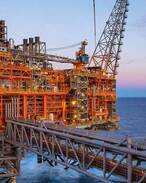
Cook says carbon storage is not new technology. Carbon dioxide injection has been around for more than 30 years for enhancing oil and gas recovery. Norway has been pumping 2800t of carbon dioxide a day into a sandstone stratum a kilometre below the surface in its Sleipner West gasfield for almost a decade. In many countries, from Turkey and Trinidad to Algeria and Brazil, as well as the US, various forms of injection and storage are now being tested.
In essence, carbon sequestration does no more that imitate nature. It uses the immense natural pressures of rock and water 800-1000m below the surface to hold supercritical carbon dioxide, which has been injected in a very compressed, dense state, in place through a natural equilibrium.
Cost will be a major determinant of whether carbon dioxide capture and storage succeeds, according to Cook.
The challenge lies in finding ways to capture the carbon dioxide which will bring down the cost from the present $50/t. It also lies in finding suitable storages close to the main centres of carbon dioxide production – coal fired power stations and to a lesser extent gas fields.
Where the match is good, the cost of storage is estimated at less than $10/t. "Overall, decreasing greenhouse gas emissions will be expensive, whether we use renewables or geosequestration, but then global warming is also likely to be expensive," Cook said.
"What we need are carbon dioxide injection projects in a diverse range of geological settings to build up experience and understanding of the requirements for safe storage. At present we are collaborating in Texas on the Frio Brine project and we are looking at possible Australian trial sites in central Queensland, the Otway Basin and the Perth Basin. Plans are well advanced and we hope to launch a pilot geosequestration project by mid-2005."
There are several possible choices for carbon storage: in unmineable coal seams, depleted oil and gas fields and in saline aquifers, which offers by far the largest capacity of the three.
According to the CRC, Australia has sufficient capacity to store current carbon dioxide emissions for 1600 years, though not all is conveniently located or suited to long-term storage. Site selection is paramount, avoiding areas that are heavily faulted where carbon dioxide might leak out. Once injected, a variety of methods can be used to monitor the carbon including seismic waves, and electro and audio-sensing.
Cook said there had been encouraging results from research into carbon dioxide capture by the CRC and other groups. For example, in the area of pressure swing adsorption, a technique in which power station flue gases pass through a zeolite filter, the carbon dioxide is adsorbed onto the filter, separated from the other gases, and then released again through pressure or electricity as a pure stream for sequestration. This offers a possible option to retro-fit existing power stations.
Down the track, however, the best hope lies in IGCC, where the carbon dioxide is separated early in the process, leaving hydrogen to provide the energy.
"We are by no means promoting geosequestration as a silver bullet for greenhouse," Cook said.
"It will be part of a mix that involves greater energy efficiency, renewables, low-carbon fuels and tree planting. But it does have a very significant role to play.
"And we will see the day when people will have to show their geosequestration plan along with plans for any new power plant or emissions source they are planning to build."
Despite Australia's image in the international media as a greenhouse recalcitrant, through the CO2CRC our scientists are making a global contribution to the Carbon Sequestration Leadership Group and to the Intergovernmental Panel on Climate Change's forthcoming report on greenhouse that, for the first time, factors in geosequestration’s potential contribution to reducing the greenhouse problem.
Professor Julian Cribb FTSE is a science journalist and communicator.