This article is 19 years old. Images might not display.
The Western Australian capital is leveraging its position as the country’s chief oil and gas city to build a name for itself as a centre of excellence for the Asia-Pacific region.
Australian Marine Complex
Since opening in 2003, the Australian Marine Complex (AMC) has provided a home to more than 80 businesses, providing goods and services to the marine, defence and resource sectors.
This year, a $20 million oil and gas training centre is expected to be completed at the AMC’s technology precinct. Established by TAFEWA, the Australian Centre for Energy and Process Training (ACEPT) will provide a range of operator and well-related training and skills development, including health, safety and environment training for the LNG industry.
When completed, the centre is expected to house about 20 teaching and administrative staff from TAFE and the state’s universities. It will cater for up to 350 students on-site and through remote web-based learning programs. A 25-member industry board, chaired by Woodside’s Keith Spence, will help guide the centre’s strategic direction to ensure it remains in touch with industry needs.
Aside from oil and gas, the AMC has also emerged as Australia’s leading marine industrial facility. As such, it is expected to become increasingly important to Australia’s offshore petroleum sector.
Fresh from a recent trip to Norway, WA’s Energy and Resources Minister Francis Logan said Perth, or more specifically the AMC, was ideally placed to become a global leader in sub-sea technology services. Now has never been a better time to develop technology in this arena, as the high oil price and over-explored petroleum basins are pushing industry into deeper and deeper waters, according to Logan.
According to new figures, worldwide spending on sub-sea processing systems is expected to reach $US3.4 billion ($A4.4 billion) between 2011 and 2015. That’s a whopping increase from just $250 million in 2001-2005.
While in Norway, Logan visited sub-sea service facilities belonging to Aserkaeverner and FransMollen, both of whom are leaders in the sector.
“We were putting the case to them that they should look at the AMC as a base from which to extend their arm into the Asia-Pacific region,” he said.
Kicking-off Logan’s vision was FMC Technologies, which became the first sub-sea technology company to set up shop at the AMC. Its first project was the refurbishment of Woodside’s Enfield sub-sea tool packages.
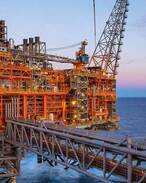
Other contract projects assembled and loaded out for marine transport from the AMC include the John Brookes and Linda platforms for Apache Energy, auxiliary equipment rooms for Woodside’s Goodwyn platform, and Australia’s first export jacket — for Shell Todd’s Pohokura gas field in New Zealand.
“We were attracted to the AMC for a number of reasons,” FMC Technologies operations manager Kevin Long said recently.
“A sub-sea cluster at the AMC would be good for the overall sub-sea industry and we support this direction.”
ChevTex and the City
Offshore drilling is becoming more technically challenging and expensive, meaning that for the time being ultra-deep exploration will probably remain a game for the supermajors.
While it’s risky, it can also yield huge returns — just ask Chevron about the 15 billion barrel oil discovery it made in the Gulf of Mexico in September. Drilled 6km deep and located in 2km of water, the Jack-2 appraisal well broke a series of world drilling records in the process.
There’s little doubt that Chevron sees a big portion of its future revenue in offshore regions and is looking increasingly towards Western Australia to make it happen.
The corporate giant is pouring millions of dollars into research and development projects with the Western Australian Energy Research Alliance (WA:ERA), a partnership between the CSIRO, the University of Western Australia, and Curtin University of Technology.
Chevron is also just about ready to open one of its own technology centres in Perth. To be located alongside its CBD office in the QV1 building, this will be the first centre to be opened by Chevron outside of its home base in the United States. Another one is also due to open soon in Aberdeen, Scotland.
The Perth Technology Centre's management are aiming to recruit 40-50 technical professionals this year
“By locating technology centres strategically alongside Chevron’s operations, we plan to deploy technology solutions faster, gain access to new technology development opportunities, and increase our access to technical talent globally,” said Mark Puckett, president of Chevron subsidiary Energy Technology Company.
Chevron is already a big name in Western Australian oil and gas. As well as being a partner in the North West Shelf Venture and the Barrow Island Oil Project, it also operates the $15 billion proposed Gorgon gas project.
Perth Energy Technology Centre manager Paul Jones, who is relocating from Chevron’s Texas office, said the facility would also support the company’s interests elsewhere in the Asia-Pacific region, which account for a quarter of its global operations.
When asked why Perth was chosen to host the next centre, Jones said the city was a hotspot for suitably qualified personnel.
“The changing landscape of the oil and gas industry is creating a much greater role for technology,” Jones said.
“Perth was selected to support Chevron’s Asia-Pacific operations due to its rich source of talented regional technology experts and as a growth opportunity to pursue R&D alliances with universities and industry partners.”
Earlier this year Chevron teamed up with the WA:ERA by agreeing to inject about $5 million each year into up to 20 R&D projects.
“We’re looking to develop and deploy technologies that will allow us to produce hydrocarbons in complex environments, such as ultra-deep waters and heavy oil,” Chevron’s US-based Rick Zalesky told delegates of the Australian Petroleum Production and Exploration Association national conference last May, not long after the relationship was announced.
“At the same time, we are researching technologies for conversion of heavy hydrocarbons to liquid transportation fuels.”
Tomorrow: Bentley Technology Park
First published in the January issue of Petroleum magazine