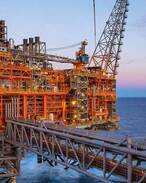
Big and important as Ichthys is, the fact that the Inpex-led consortium finally signed off on the development is not what anyone would call hard news. If the go-ahead decision had not been made after a decade of planning and design then that would have been news.
As it is, Australia will now get its seventh - or is it the eighth? - LNG development and remain on track to overtake Qatar as world's top LNG exporter sometime in the next decade or so.
Wien and Hess are in a different category of news. They are the real thing because one of the men knows an awful lot about money and the other knows an awful lot about oil and gas - and both are talking shale.
What happened last week, as Inpex was signing off on Ichthys, was the airing of Wien's views on shale and the announcement by Hess of the exploration and development budget of the company he runs, Hess Corporation.
Wien, who is probably not well-known in the oil and gas world, is a senior managing director of the investment firm, Blackstone Group, a prominent commentator on economic trends, and a man who every year nominates 10 possible "surprises" for the year ahead.
His top tip for the surprises of 2012 is the rise of shale gas and shale oil as a global "game changer". According to Wien, rising production from shale will help push the price of oil back to around $US85 a barrel and the US will become less dependent on Middle East supply.
Hess seems to agree because the budget he has signed off for the firm which carries his family name is "shale heavy", or to be more technically correct, unconventional heavy.
Of the firm's $US6.8 billion capital expenditure and exploration for 2012 a remarkable 37% has been allocated to unconventional targets, mainly in the Bakken shale of North Dakota, the Eagle Ford shale of Texas and the Utica shale in Ohio.
Hess said in a statement accompanying the budget report that he believed the investment in unconventional oil and gas was "lower risk and will generate long-term profitable growth."
On a dollar-for-dollar basis, it seems to The Slug that Hess has just made the biggest single commitment of any oil and gas company to unconventional hydrocarbon sources.
In other words, Hess and Wien are singing from the same hymn sheet, with both men recognising that the oil and gas game is changing much more rapidly than many participants in the industry realise - and infinitely more quickly than anyone on the outside understands.
In a way, Ichthys is the old world of oil and gas, enormously capital intensive and perhaps destined to not be as profitable as might have been expected if the oil price does what Wien suggests thanks to the exploration and discovery work of people like Hess.
None of that means the attraction of conventional gas will be downgraded, but it does mean that when it comes to attracting capital allocation there is a new rival clamouring for attention and funding.
In the case of Hess, that $2.5 billion on unconventional gas dwarfs the modest capital allocations so far on the company's conventional offshore gas discovery in Australia, Equus, where early contracts have been let for preliminary front-end work.
Interesting as the early work on Equus might be, the dollar figures tell a different story because all that Hess has tossed to the engineering design team at Wood Group Kenny is an $8 million job lasting 12 months to deliver a scope of work report.
More spending might follow on Equus but to an outsider it seems that Hess is doing enough to keep alive its hold on the WA390P tenement, where water depths are around 1200 metres, while throwing the kitchen sink at unconventional sources of oil and gas because they look to be less capital intensive and more profitable in a changing oil and gas world.