

The Pilbara's mining giants are caught between a red rock and a hard place: either double down on building their own power lines or back a shared electricity transmission network that promises $30 billion in savings and the renewables needed to decarbonise one of Australia's most carbon-intensive regions.
The Clean Energy Finance Corporation (CEFC) is pushing hard for the latter. A study commissioned from consultancy Marsden Jacob Associates argues that "common user transmission infrastructure" (CUTI) - a shared network - could slash costs, speed up the energy transition and reduce the land footprint of new projects.

"The opportunity is to build once, build right and deliver cost savings alongside emissions reductions," CEFC's WA executive director for resources and industrials, Rob Wilson, told Energy News Bulletin.
YOU MIGHT ALSO LIKE
"At the moment, we've got just 2% renewables up there. This is about getting the right infrastructure built to unlock decarbonisation."
The economics of scale
The CEFC-commissioned modelling tested three scenarios: miners funding separate networks, a partial shared build and a fully integrated grid. The results were blunt.
Transmission costs are 40% higher and generation costs 25% higher under the "go-it-alone" model. By contrast, CUTI requires 17% less transmission line length and 19% less renewable and storage capacity to deliver the same outcomes.
That translates into about $30 billion in avoided costs over 25 years, plus a 12,500-hectare reduction in land disturbance. For a region where native title disputes are intensifying, the smaller footprint is not just an environmental benefit but a legal and reputational one.
"This isn't just about miners," Wilson said.
"It's about the wider Pilbara and the wider decarbonisation challenge. A common grid lowers barriers for green industries in particular, and ensures coastal projects can access inland wind resources that otherwise wouldn't be viable."
A resilience argument
Miners argue that reliability is paramount. In the Pilbara, a single day of downtime can cost millions. But the CEFC contends a shared grid would actually strengthen resilience by linking isolated systems and spreading variable renewables across a broader geography. By the mid-2030s, a CUTI system could host 4GW of solar, 5GW of wind and 6.3GW of batteries. Gas would remain, but only as a backstop.
Avoiding fossil fuel use at scale equates to 3.6 billion litres of diesel and $2.2 billion of gas saved annually, while cutting emissions by up to 35mtpa.
"Without CUTI, it's hard to see how the Pilbara delivers the renewables scale needed for net-zero mining, let alone green hydrogen and ammonia exports," Wilson said.
Governance tensions
The hardest sell is governance. Typically, go-it-alone miners are deeply resistant to subsidising rivals or ceding control over pricing and access.
"You know, do their lines become part of a larger, common user grid? And then, how so?" Wilson said.
"Currently, the Pilbara operates under a light-touch regulatory approach. That will evolve, but it needs to be appropriate for a bilateral contracting environment."
But he also acknowledged the "fine print" is far from resolved.
"These things don't happen overnight. What's needed now is escalating levels of engagement so miners can build confidence and clarity on getting the right assets built."
Wilson said governance fears should not be overstated: "In the rest of the world, and even on the east coast of Australia, a common user grid is a normal approach. These are sophisticated commercial parties — they're not shy of looking after themselves."
The role of government
The WA government has mapped four priority transmission corridors and launched a Pilbara Energy Transition Plan to bring industry and Traditional Owners into the process. Canberra has offered up to $3 billion in concessional finance from its Rewiring the Nation program to reduce capital costs.
"We're not saying miners should commit today to something they don't even know the solution of," Wilson said.
"But through engagement, they can build levels of commitment, and funding can help fill early gaps. These are 30- to 50-year assets — the capital will be fully recouped."
He stressed that the model does not imply government ownership.
"The question is really about getting the balance right on regulation. Access has to be managed, but the harder thing is actually getting these things built."
Native title flashpoint
The timing is delicate. The Yindjibarndi people are pursuing a $1.8 billion compensation claim against Fortescue Metals Group — one of the largest native title cases in Australian history. Justice Burley is expected to rule in coming months.
The CEFC insists CUTI would ease rather than exacerbate land tensions - by cutting duplication and streamlining approvals, Traditional Owners would face fewer overlapping corridor proposals and earlier engagement.
"Many Traditional Owner groups understand the climate challenge," Wilson said.
"They want to minimise disturbance on their land. If we don't go this route, they risk withholding approvals if they foresee multiple transmission lines."
Staged evolution
Wilson said CUTI would not arrive in a single sweep but through staged development of critical corridors.
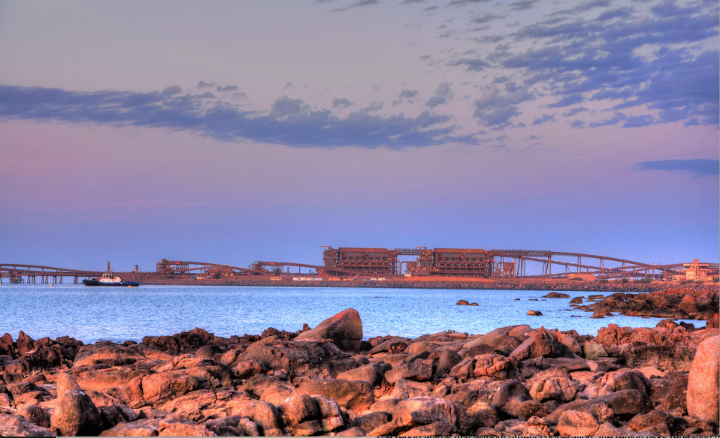
"Right now, two fundamental ones stand out: from the Burrup Peninsula south, and from Port Hedland down to Newman. The question is how they evolve and at what pace."
He rejected the "build it and they will come" notion.
"We think there's a more analytical approach, based on demand profiles. We fundamentally believe these assets will be fully utilised."
Reliability, he said, would evolve.
"Currently, miners have their own firming capacity on site. That won't change in the short to medium term. Over time, the grid can take on more of that role."
The stakes
The Pilbara is responsible for nearly a quarter of Australia's industrial emissions. Its decarbonisation will be pivotal not just for miners' social licence but for Australia's export competitiveness as trading partners tighten carbon border rules.
For Wilson, the CEFC findings amount to a "rare win-win": cheaper energy, fewer emissions, and stronger community outcomes. But the choice lies with industry.
"I think the critical thing now is to avoid unnecessary duplication," he said.
"Nobody wants a plethora of transmission lines cutting across their land. If we do this properly, we can cut more than 20% of the footprint. The question is whether industry can move with enough urgency — or whether the Pilbara defaults to fragmented growth at far higher cost."