

While sails have been used to power boats and ships almost since man first clambered into a boat, it has been a long time since they have been used in commercial shipping for a long time. However, an expert in the technology says modern sails are ideally suited to bulk carriers and oil and gas tankers.
"Bulkers and tankers are the sweet spot for wind-assisted shipping. They don't travel as fast as container ships - creating a lot of apparent wind and making it hard to create aerodynamic lift - and also don't have the loading and unloading constraints that container ships would have with sails," says Andrew Dickson, a board member of the Smart Energy Council in Australia and former presenter and mentor in Al Gore's Climate Reality Project.
However, what makes Dickson's thoughts on the matter particularly noteworthy is that, as well as having grown up racing sailboats and having spent 10 years in the Royal Australian Navy and more than 20 years developing wind farms, he last year won a Churchill Trust Fellowship grant to investigate the potential for wind-assisted ship propulsion to help decarbonise commercial shipping.

YOU MIGHT ALSO LIKE
"Over six weeks in June and July, I travelled to Singapore, the UK, France, the Netherlands, Germany, Denmark and the Marshall Islands," he told ENB.
"Modern wind-assisted ships are a real thing: the technology is mature, and it works well, it is starting to be deployed at scale, and it will help us to afford the more expensive solutions which will be required later as we decarbonise shipping further.
Dickson said Australia can leverage the sector across the Asia Pacific, highlighting the threat to neighbours reliant on costly, imported, dirty shipping fuels.
"We can help them to scale this proven solution through a combination of bilateral or multilateral funding, the provision of training and other capability building, and support for local maritime innovators," he said.
Recent data show 77 large merchant ships are currently equipped with wind propulsion systems, and a further seven are "wind-ready," awaiting or undergoing wind-assisted ship propulsion (WASP) installation.
Additionally, more than 130 ship installations of wind propulsion systems are on order, most for delivery in 2025/26, with analysis indicating the number of ships installed with WASP roughly doubles each year.
The 2019 UK Clean Maritime Plan projects WASP could be installed on almost 11,000 ships by the end of 2030 and up to 40,000 ships by 2050 - about 45% of the global fleet.
"If the shipping sector was a country, it would emit more than Germany and more than double that of Australia. And on a business-as-usual trajectory, shipping emissions are projected by the IMO to rise by as much as 40% by 2050," says Dickson.
"Notably, almost 40% of all shipping (by volume) is involved with transporting energy commodities in the form of crude oil, refined petroleum products, liquefied natural gas (LNG), liquefied petroleum gas (LPG), and coal.
"This makes energy the largest single category in global seaborne trade, ahead of bulk agricultural goods or containerised cargo."
Progress
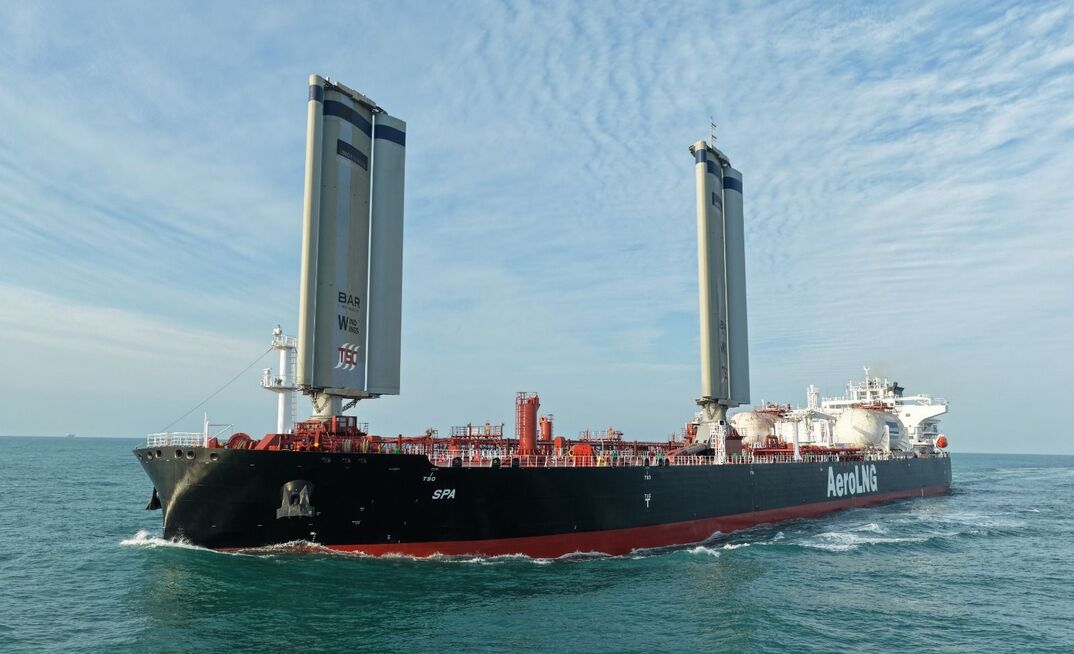
In a recent development last week it was announced that Union Maritime has taken delivery of the Long Range 2 tanker, Spa, built by China's Yangzijiang Shipbuilding which has been fitted with two WindWings from UK wind sail company, Bar Technologies. The firm claims is the world's first LNG and wind-powered LR2 tanker.
Union Maritime's Managing Director, Laurent Cadji, who set up the company 20 years ago, commented: "The delivery of MT Spa marks an important step in the delivery of our long-term strategy. By combining LNG dual fuel capability with wind-assisted propulsion, we are investing in solutions that deliver tangible emissions reductions today, while retaining the flexibility required for the future. This approach underpins our fleet renewal programme and our commitment to decarbonisation at scale.
In September last year, Mitsui OSK Lines (MOL) announced it had obtained approval in principle (AIP) from Lloyd's Register for two new designs of a membrane-type LNG carrier, each equipped with four hard sail wind-assisted propulsion units.
The AIP covers two different vessel designs for a 174,000-cubic-metre LNG carrier.
One design was jointly developed with HD Hyundai Heavy Industries and has earned an AIP from the Marshall Islands flag state.
The second design, jointly developed with Samsung Heavy Industries, has received an AIP from Liberia.
Based on preliminary calculations, MOL expects fuel savings of up to 30% per voyage, with an average annual saving of 15%-20% and plans to install wind-assisted propulsion units on 25 vessels by 2030 and on 80 vessels by 2035.
Early successes
In his report, Dickson cites the promising successes seen by the early adopters of WASP technologies:
TOWT - on the Le Havre to Guadeloupe route, TOWT vessels emitted as low as 1.59g of C02 per tonne (gCO₂/t.km) transported per kilometre travelled, compared to 20 gCO₂/t.km for regular container ships on this route. TOWT also reductions of 98% sulphur oxides, 92% nitrogen oxides and no methane.
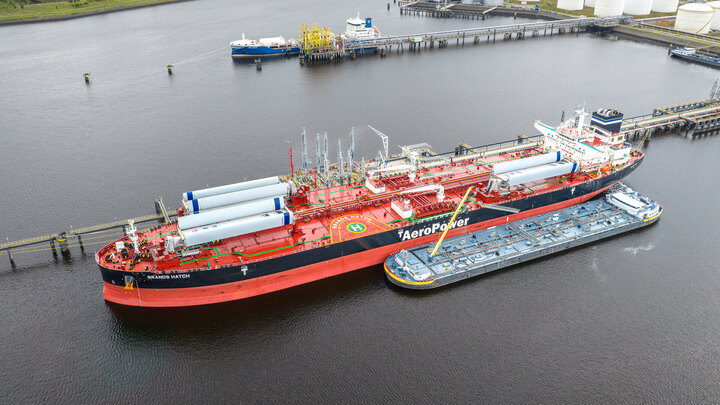
Union Maritime – fitted with three of BAR Technologies' 37.5m-high WindWings, the fully laden Brands Hatch used just 12.8 tonnes of fuel in 24 hours, equating to 13 tonnes of CO₂ avoided per sail, per day.
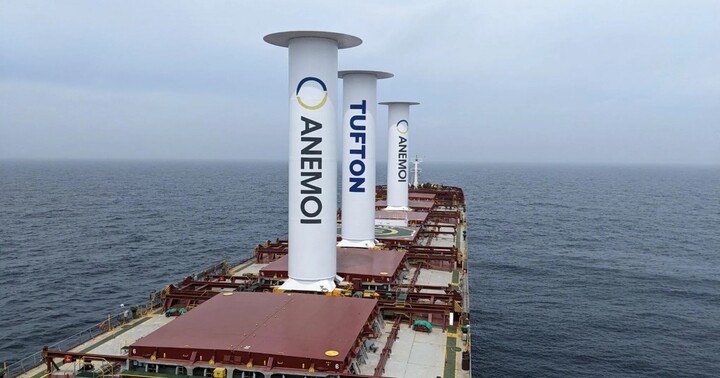
Tufton Investment Management – fitted with Anemoi Marine's rotors, the Kamsarmax bulk carrier TR Lady achieved an average 9.1% net propulsion fuel and emissions savings, or 1.9 tonnes of fuel per day and seven tonnes of CO2 per day.
Louis Dreyfus Armateurs (LDA) - chartered to Airbus and fitted with Bound4blue's 22m eSAIL suction sails, the Ro-Ro vessel Ville de Bordeaux saw average daily fuel savings of 1.7 metric tonnes, with peak savings of as much as 5.4 metric tonnes per day.
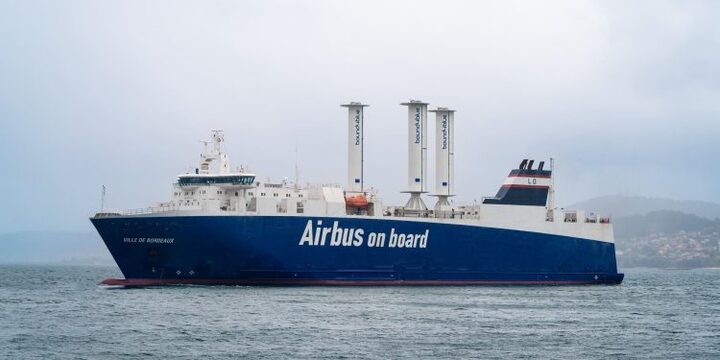
Dickson says the suitability of WASP to be added to new or existing bulk carriers and tankers means it is unsurprising that most WASP installations to date are on these vessels.
"There are tens of thousands of such vessels suitable for WASP deployment, either as retrofits or newbuilds," he adds.

"As a long-term renewable energy developer, WASP feels to me today as solar photovoltaic felt two decades ago. Deployment of solar PV started out modestly but then grew very quickly, and today over 50% of households in my home state of South Australia have solar PV systems fitted, and rooftop solar occasionally provides the entire electrical demand in South Australia.
"WASP deployments may follow a similar path if the policy settings are right and if shipping companies and customers act boldly to embrace the benefits that WASP can deliver them."