This article is 10 years old. Images might not display.
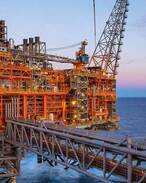
The world's largest independent exploration and production company based on proved reserves and production of liquids and natural gas announced yesterday it intended to reduce future deepwater exploration spending, with the most significant reductions coming from the operated Gulf of Mexico program.
ConocoPhillips chairman and CEO Ryan Lance said the decision to cut deepwater spending should stabilise the cash flow situation.
"Since the start of the oil and gas price downturn last year, we have moved decisively to position ConocoPhillips for lower, more volatile prices by exercising capital flexibility and reducing operating costs across our business," Lance said.
"Our decision to reduce spending in deepwater will further increase our capital flexibility and reduce expenses without impacting our growth targets.
"This strengthens our ability to achieve cash flow neutrality in 2017 even if lower commodity prices persist.
"We have achieved some notable success in our deepwater program, particularly in the Gulf of Mexico Lower Tertiary play and offshore Senegal.
"We are committed to delivering the value we have created from these discoveries, while reducing the number of deepwater exploratory prospects we drill in the future."
ConocoPhillips also revealed it would terminate its contract for the Ensco DS-9 deepwater drill ship, which was scheduled for delivery to the Gulf of Mexico in late 2015 to begin drilling the company's operated deepwater inventory on a three-year contract.
Under the terms of the contract, the company is subject to a termination fee that represents up to two years of contract day rates. While details of the termination are under discussion, ConocoPhillips expects to take a special item charge for termination in Q3.
"Our actions reflect a decision to reduce exposure to programs with greater resource risk and longer cycle times," Lance said.
"However, we will continue to pursue organic growth through more focused exploration programs.
"Furthermore, with increased capital flexibility, we can direct more investment to our captured resource base of 44 billion barrels of oil equivalent, which includes significant identified inventory in the highest value areas of the Eagle Ford, Bakken, Permian and Western Canada unconventional plays, as well as our legacy businesses around the world.
"We believe this will accelerate value for shareholders by shortening the cycle time on our overall investment program."
US investment advisor Stone Fox Capital said Iran was the biggest issue for oil markets right now, over and above shorter-term concerns like Greece and China - especially for ConocoPhillips, whose New York stock hit new 52-week lows after testing the $60 level numerous times in the last year.
Stone Fox said that while ConocoPhillips was "holding up well" thus far in the market sell-off, its stock could well be headed lower, especially given the US major has long-term plans to turn cash flow neutral with oil prices at $70/bbl.
This oil price will be unlikely if the International Atomic Energy Agency verifies Iran's compliance to reduce its uranium stockpiles and number of centrifuges and the nuclear-related trade sanctions, including oil, on the Islamic Republic are lifted - which is, in any case, not expected to happen for at least another year.
If that happens, Iran expects to double its production, adding another 1MMbpd to an already oversupplied market.
Stone Fox said the biggest issue was that Iran might flood the markets with up to 40MMbbl on day one of the sanctions being lifted due to excess supplies in floating storage.
Iran currently produces roughly 1.2MMbpd of oil and the estimates are that it would take roughly 18 months to get up to the new production targets. Yet it still adds more oil supply to the markets within a relatively short-time period.
It would also help offset any deficits expected from reduced output plans from Brazil and Iraq.
Conoco concerns
Stone Fox said the recent oil price plunge questioned the very essence of ConocoPhillips' plan to turn cash flow neutral with oil prices at $70/bbl, considering it requires oil prices to jump while the company continues increasing production.
While ConocoPhillips continues paying an annual dividend of $2.92 that is equivalent to a 5% yield, Stone Fox warned that the US major doesn't have the cash flow to support this dividend and the forecast for 2017 requires $70 oil to reach a level where it can afford capital spending and the large dividend.
"The bad part of the current situation is the company suggests that normalised cash flow in 2014 with $70 oil was $12.5 billion," Stone Fox said.
"Production growth and $1 billion in operating cost reductions gets them to the cash flow needed to cover the dividend.
"The numbers though suggest that even the lower operating costs would only see cash flow hit $13.5 billion. With oil back at $50/bbl, ConocoPhillips is likely hardly covering capital spending of $11.5 billion."
Stone Fox suggested that the worst part of the scenario was that ConocoPhillips required production increases to account for $2 billion in cash flow gains.
"These increases in production are only helping contribute to lower commodity prices," Stone Fox said.
"In the current pricing environment, the company will have to continue borrowing to pay a substantial portion of the dividend, if not all $4 billion of the annual cost."
For now, ConocoPhillips is defying the analysts, announcing yesterday it would increase its quarterly dividend from US73c/share to 74cps, payable on September 1.