The week in review

Too many cooks spoil the broth, is the old adage.
And while it might usually be applied to the notion of too many people chipping in with their opinions and interventions while working in close proximity, it could also be applied to the state of Australian politics.
Is it possible we just have too many governments?
Today, the Queensland's energy minister David Janetski will unveil the state's five-year energy roadmap, with the toplines being the continuing reliance on coal fired power stations into the 2040s and even beyond and the planned development of a new 400-megawatt, gas-fired power station which could be online within seven years.
Similarly, Janetski's expected to forecast the state's gas generation capacity will more than double from 3.5 gigawatts now to between 6.1 and 8.3GW in 2035.
These state government plans – while possibly serving the best interests of the good people of the Sunshine state – put it directly at odds with the aspirations of the federal government which is desperately trying to bring down country-wide emissions.
A few weeks ago, the Prime Minister confirmed a target to cut emissions by 62 to 70% below 2005 levels by 2035, requiring more than 90% of electricity to be generated by renewables.
But with the Treasury modelling used to design these figures based on the idea that "coal-fired generation is projected to mostly exit Australia's electricity system by 2035", this target is seriously threatened by Janetski's move.
When today's announcement was hinted at by the state's premier David Crisafulli a few weeks ago, it triggered a wave of criticism from Canberra, with environment minister Murray Watt accusing the LNP of "short-sighted decisions" risking higher power bills and threatening the federal government's targets.
"Any delay in the transition towards cheaper, cleaner energy powered by renewables, backed up by gas and batteries, is only going to increase the risk of power price rises for Queenslanders and the risk to jobs that comes with that," said Watt.
He even pulled on the heartstrings, referencing an Australian natural icon, adding: "delaying the transition to cheaper and cleaner renewable energy puts our climate at risk and, in turn, threatens environmental assets like the Great Barrier Reef and our wet tropics rainforests."
And the same state vs federal battle is seen with the Western Australian government's refusal to curb its emissions, clinging to the mantra that the state's higher, LNG-derived emissions are a necessary evil and the price to pay for helping other nations decarbonise.
Likewise, the state's vehement opposition to the now dropped Nature Positive Bills, promoted by former environment secretary Tanya Plibersek. It was WA premier Roger Cook's personal intervention which prompted PM Albanese to step in to quash the bills, after Cook highlighted the effect they would have on WA industry, the powerhouse of the Australian economy.
Vested interests are understandable, and competing priorities are pretty much de rigueur in politics, but trying to cajole the states and territories governments into line in a way that reflects and supports the objectives of the federal government seems akin to herding cats.
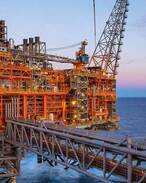
On another issue, as the Northern Endeavour nears the end of its journey to Singapore this weekend, where it will be given a touch up before being loaded on to the back of a Chinese low-loader and taken to Denmark for decommissioning, ENB brings news of a praise-worthy initiative.
Crew members from a range of different contractors involved in this stage of the decommissioning process have decided to run, ride or row the full 3,500km tow distance from the Laminaria-Coralina oilfields to Singapore.
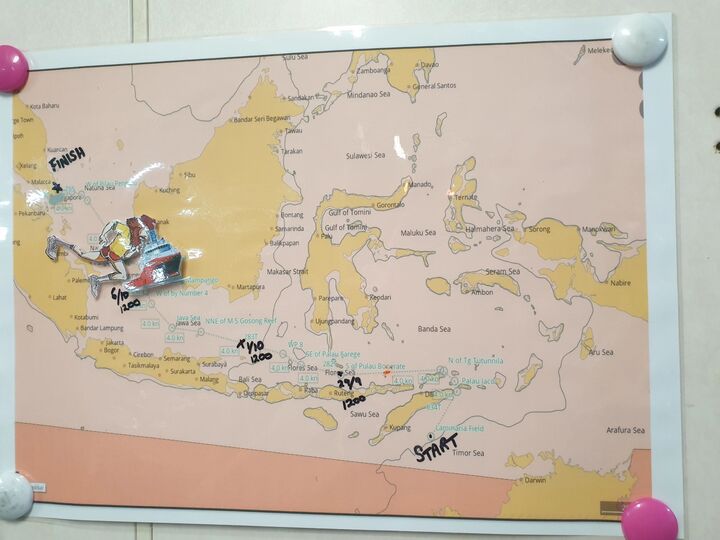
"Different companies, different backgrounds, one big goal. Every kilometre logged means effort, teamwork and a shared sense of purpose. It's proof that even huge goals become achievable," said one of the participants.
"We might be miles from shore, but the energy, laughter and camaraderie on board make it all worth it. Because when people thrive, the whole operation thrives," he added.
A great effort to help keep both body and mind fit.
Yours,
Russell Yeo
Editor
Energy News Bulletin
To get the best analysis and insight of what's happening in APAC's energy sector, sign up for a free trial.