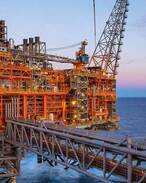
The Northern Endeavour today set off on its last journey, leaving the Timor Sea for Singapore enroute to its final destination – a breaker's yard in Denmark.
And with its departure ends a long and sorry tale of what was once a gleaming and productive floating production storage and offloading (FPSO) – producing more than 200 million barrels of oil from 1999 to 2015.
And while the ship currently being unceremoniously towed to Singapore is now a filthy, rusty, former shadow of itself, it was once a happy vessel on which to work.

Take a look at some of the comments from previous crew members.
"I spent nearly five years onboard, and the team truly felt like family. Many of those friendships have lasted to this day…
"She was a special FPSO — ahead of her time in both design and capability. Grateful for the experience and the people who made it unforgettable…
"My first offshore trip was the NE, and I've been spoiled by it ever since. Never have I been in such a beautiful facility, and the crew was pretty awesome too…
"It really does feel like losing a part of our family sending her off on her decommissioning journey…
"The NE was always such a unique FPSO, a unique culture that was so different from other Woodside assets and other FPSOs…
"She stands among the best facilities and crews I've had the pleasure of working with, and I'll truly miss that."
So how did what was once such a valuable and loved asset end up on the back of a Chinese towboat? ENB takes a look back at the Northern Endeavour's eventful life.
The Northern Endeavour has spent the last 20 years plus, tethered to the ocean floor above the Laminaria-Corallina fields, about 550km northwest of Darwin, but it started its life in Samsung Heavy Industries' South Korean shipyard following the signing of contracts in September 1996.
After being fully fitted out by the FPSO consortium Kvaerner-SBM the following year, a unit operating agreement was set up to create a joint venture across the Laminaria and Coralline fields and the FPSO itself, with Woodside the major shareholder alongside minor partners BHP and Shell.
The initial development, covered by Production Licence AC/L5, consisted of three wells on Laminaria and two on Corallina, with excess gas being reinjected through a dedicated gas-injection well, East Corallina-1.
Production started on 7 November 1999, with total project costs reported as A$1.37 billion.
In 2002, in recognition of the richness of the field, two additional infill wells were drilled for Laminaria and tied back to the Northern Endeavour with a sidetrack well (Corallina-2 sidetrack-2) drilled and tied back to the FPSO in 2009.
Output on the vessel was spectacular, and it proved to be an extremely successful and lucrative operation for the JV.
"I was part of her journey from the very early days — my first offshore assignment. I still remember the day she was producing 202,000 barrels when I arrived. I spent nearly five years onboard, and the team truly felt like family. Many of those friendships have lasted to this day," said one former crewmember.
And the figures gathered from Woodside's annual reports back this up - 54.3 MMbbl in 2000 – not a bad start to the new millennium.
But these heady days lasted only a brief few years, and by 2004, it was producing just 10.5 MMbbl, and output was on a downward trajectory.
With this in mind, it was in the same year that BHP announced it would sell its stake in both fields and the FPSO to incoming JV partner Paladin Resources. In their statement, the mining giant at the time said the move was being taken as "part of the company's active portfolio management strategy. Following a review, BHP's interests in the fields were identified as being non-core to its future petroleum strategy."

The next year, Shell followed BHP out the door, selling their stake to Woodside and Paladin.
Woodside's then CEO Don Voelte said the agreement would consolidate Woodside's ownership in one of its key assets, adding, "We supported the entry of Paladin into the joint venture because they shared our view of the investment opportunities in and around Laminaria-Corallina. We are each increasing our interests and are committed to working together to realise the full potential of these assets."

Later in 2005, Canadian oil giant Talisman Energy agreed to buy out Paladin Resources, leaving the JV now in a very different position from its original makeup. Now, the Corallina/Northern Endeavour ownership was split between Woodside (66.67%) and Talisman (33.3%), and the Laminaria field was split between Woodside (59%) and Talisman (41%).
Fast forward to 2015, and with production down to just 1.4 MMbbl, in July, Woodside informed regulators they were planning to decommission the aging vessel in the second half of the following year. Never one to shy away from hedging their bets, Woodside also put out feelers to see if there might be a buyer willing to take the vessel off their hands.

And so it came to pass on 29 September 2015 that Woodside and Talisman signed the Laminaria–Corallina Sale Agreement, which created Northern Oil & Gas Australia Pty Ltd (NOGA) - a newly formed company with Angus Karoll as its sole director, which would take control of Talisman by a 100% share purchase.

Under this deal, Talisman would acquire Woodside's share of the AC/L5 licence as well as ownership of the Northern Endeavour and all subsea infrastructure.
Early the following year, NOGA rebranded as Timor Sea Oil & Gas Australia Pty Ltd (TSOGA), taking over from Talisman Energy. It then contracted Upstream Production Solutions (UPS) to handle maintenance and operation of the facility for three years.
And on 9 April 2016, UPS became the safety case holder for the facility following NOPSEMA's acceptance, with Woodside officially walking away from the Northern Endeavour on 12 September 2016.
The vessel was now about 20 years old, and the cracks were starting to show.

So much so that on 10 July 2019, NOPSEMA issued a prohibition notice to UPS, and then eight days later, a general direction ordering TSOGA to stop production immediately and to address a range of long-standing issues, particularly relating to corrosion and safety systems.

And while the Northern Endeavour had still been producing, NOGA's pockets were not deep enough to meet NOPSEMA's requirements and re-establish production. Then, on the 20 September 2019, the company went into voluntary administration. The Northern Endeavour was de-crewed and put into a "lighthouse mode."

Early the following year, creditors backed administrator KPMG's recommendation to wind up NOGA.
"At the meeting of creditors on 7 February 2020, creditors resolved to wind up the Companies and the Administrators were appointed Liquidators of the Companies," – the creditors said in a blunt statement.
With insufficient funding to continue operations, the vessel and the subsea assets fell into the hands of the Australian federal government and announced plans to decommission it.
Keith Pitt, the then minister for resources, water and Northern Australia, said: "The decision sends a strong signal to the world that Australia will maintain its global reputation as a safe, reliable and responsible country for offshore oil and gas development."
He also, at that early stage, added that taxpayers should not be left to bear the costs.
"We have been working closely with the offshore oil and gas industry on proposals to recover the costs," Pitt said.
However, so as not to burden the taxpayer with the millions needed for this mammoth project, the government was determined to have it paid for by industry, and so in 2021 worked to enact the Offshore Petroleum (Laminaria and Corallina Decommissioning Cost Recovery Levy) Act 2022 (Cth), which was designed to cover all costs of the decommissioning.
Pitt said the levy was an "important measure to ensure taxpayers aren't footing the bill for the decommissioning and remediation of the oilfields, northwest of Darwin in the Timor Sea."

When established, the levy – predictably very unpopular with the industry - was applied to all offshore production title holders and was calculated on a per-barrel of oil equivalent produced basis. As a result, as they pointed out in the consultation during the bill's drafting, Chevron would pay the greatest share of the levy, despite receiving no economic benefit from or involvement in the Laminaria-Cor oil fields.
The industry's lobby group APPEA (now known as AEP) called it a "terrible precedent," adding: "To slug an entire industry at $0.48 per barrel and not put an end date on it is over the top."
Nevertheless, with the funding in place, the government now needed a leading contractor and so, in a $324.89m deal in 2022, appointed Petrofac to assume operatorship of the FPSO in addition to performing Phase 1 of decommissioning works.
The new resources minister, Madeleine King, said at the time: "The Government will work closely with Petrofac and regulators to ensure the safety of workers on the Northern Endeavour, and to protect the environment."

Later in the year, Wood was awarded the role of Owner's Team by the Australian government, with responsibility for overseeing the first decommissioning phase of the Northern Endeavour. In October, Petrofac took operatorship of the vessel on behalf of the government, a milestone the company described as a "huge step in the landmark decommissioning contract."
The following year, things started to happen.
In May, the government revealed its plans for the first phase of decommissioning, to disconnect the FPSO from the wells that connected it to the seabed and then tow it to a scrap yard.
"Decommissioning activities, which will commence in Q2 2023 and cover a range of activities associated with flushing of the topsides and subsea equipment, suspension of the wells, disconnection of the FPSO and the commencement of towing," the government said in an environmental plan.
Then, in July 2023, the government launched the tender process for the work to disconnect, decommission, and rehabilitate the seabed itself, with Xodus being brought on board in the same month to provide technical and project support services for Phase 1 of the decommissioning of the FPSO.
The following month, Australia's Department of Industry, Science and Resources (DISR) said it had received approval under the Environment Protection and Biodiversity Conservation Act to tow the FPSO to a shipyard in Asia for decommissioning.

But it is no simple task to tow and decommission a vessel the size of the Northern Endeavour, and so in May 2024, the government contracted BE&R Consulting to provide independent advisory services on the technical requirements and risks of transporting the vessel to a recycling yard, subsequent recycling activities, and waste disposal management.
While the government was preoccupied with the how and the who of the project, the companies that had been forced to pay for the work were still very discontent with the levy, with Shell starting legal action in May against Woodside and Paladin to try to recoup more than $86.5 million of clean-up costs.
Shell's writ filed in the WA Supreme Court stated it should not have to pay for the clean-up, arguing Woodside's and Paladin's liability was spelled out in a specific clause in their share purchase agreement.
This legal complication notwithstanding, in October 2024, the government released the terms of the contract for the removal and dismantling of the 274-metre-long facility and put the job out to tender.
This year has seen a lot of progress with the vessel – leading up to today's departure to Singapore.
In March, the government contracted COSCO Shipping Heavy Transport to dry tow the Northern Endeavour using the Hua Rui Long semi-submersible heavy transport vessel, the third largest vessel of its type in the world. They also announced at the same time that an extensive well suspension and flushing campaign had been successfully completed as part of the FPSO decommissioning program.

But while progress was swift, it was not all plain sailing with news in May that the Northern Endeavour had been without power for weeks in the Timor Sea.

A power failure forced the evacuation of the crew on the disused vessel, prompting the unions – never one to miss an opportunity - to send a five-page letter to the resources minister Madeleine King, industry minister Tim Ayres, employment minister Amanda Rishworth and assistant regional development minister Anthony Chisholm, labelling Petrofac as an "absolute disgrace " and calling for swift and decisive action.

However, this major hiccup aside, in May it was announced engineers had disconnected it from the Corallina and Laminaria oilfields, which DISR described as a "significant milestone that reduces risk to people and the environment."

Seven weeks later, it was announced the power had been restored to the vessel, with Shane McWhinney from the Northern Endeavour team at DISR explaining, "The main generators were out for maintenance, and then we had a failure of the emergency diesel generator, which just triggered a whole load of other things, and then we just lost complete power."
Later that month came a headache of a different sort – bad PR – when it was announced that due to a lack of decommissioning facilities and expertise in the Australian maritime and energy sectors, the Northern Endeavour would be towed first to Singapore and then finally to Denmark to be dismantled.
Predictably, the unions were unhappy with the decision to award the disassembly contract to Modern American Recycling Services, Europe (MARS).

Paul Farrow, the national secretary of the Australian Workers' Union – one of the many unions to condemn the move - said: "It is deeply disappointing to see the government considering shipping the Northern Endeavour overseas rather than harnessing this opportunity to support local industries and workers. "Decommissioning offshore facilities domestically isn't just about preserving jobs—it's about creating new ones and bolstering our steel manufacturing capabilities.
"We strongly urge the government to reconsider this proposal. The Northern Endeavour and other decommissioned facilities represent not just environmental responsibility, but an important economic opportunity for Australian industry and communities."
While the unions may still be hoping for a miracle, the government ploughed on and last month granted integrated energy services company Kent the $12 million contract to provide technical advisory services to support the permanent plugging and abandonment of the Laminaria-Corallina oilfields in the Timor Sea as the Northern Endeavour leaves the area.
The dedicated Northern Endeavour Branch of DISR awarded the contract, having advertised the need to find a "range of technical advisors to provide reliable and timely information on Phase 2 (plugging and abandonment) and Phase 3 (removal of subsea infrastructure) activities."