

Anthony Albanese is facing a tough battle to ensure the nation's oncoming wave of data centres is powered by renewable energy sources rather than gas turbines.
Today, the prime minister unveiled his government's plans on how they would seek to control the sector's roll-out, ensuring they are a benefit to the communities in which they'll live, and not a drain.
"We will create a legal obligation for the next generation of large-scale data centres to underwrite new power supply, to pay their full share of grid connection, so no costs are passed on to homes or businesses. And to put at least as much energy into our grid as they take out of it.
"To be net-generators, not net-users, to build new renewable generation – and firming – to strengthen our national energy resilience and ensure data centres do not increase power prices for Australians," he told an audience at the University of Sydney.
YOU MIGHT ALSO LIKE
Having announced earlier this year that data centre developers are expected to bring with them renewable power and not negatively impact local community resources, Albanese said he will be seeking consensus on this from state and territory leaders at next month's national cabinet and is aiming to bring legislation to Parliament early next year.
Framing his government's efforts to grasp the nettle early and attempt to regulate AI is similar to Australia's early implementation of Medicare and the social media ban for minors, Albanese said: "Our power, our agency, our choice lies in embracing change and shaping it. Not just adopting or accommodating AI. Designing it, making it, building the capability right here. And building our sovereignty – and our economic resilience as a result."
To reiterate the urgency, he added: "We cannot revisit this issue after companies have built whatever they want, wherever they want and try and then re-open negotiations."
However, if the manner in which data centres are being powered around the world is anything to go by, Albanese has a tough road ahead, as highlighted in today's new GenCost report from CSIRO and the Australian Energy Market Operator (AEMO).
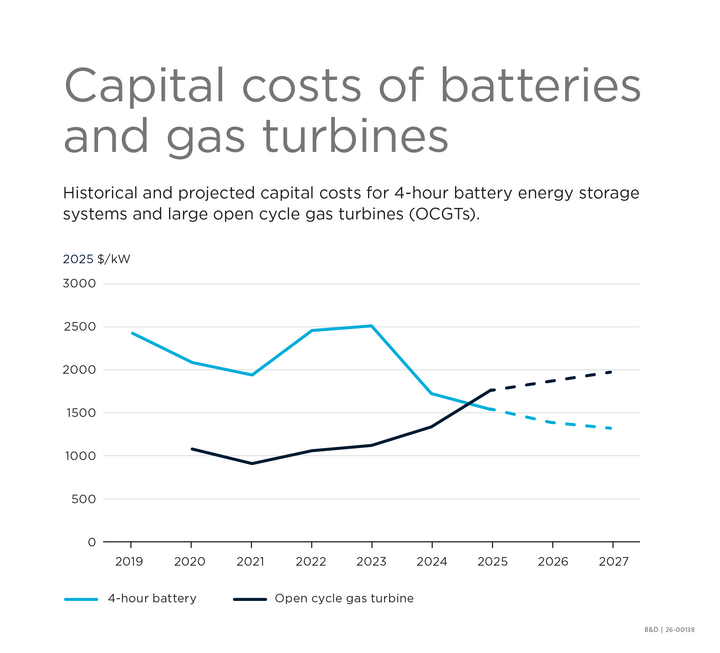
Speaking to ENB in advance of the release of the report, its lead author Paul Graham explained data centre growth has sparked a surge of demand for gas turbine generated power, not the clean power being called for by the Australian government.
"In the US, because of the scale of the data centres they need to develop, they have just been building dedicated gas turbines to run those new data centres. And in the US, data centres [have] become the second largest source of orders of gas turbines.

"That's really pushed up gas turbine costs. From Australia's perspective, that's seen the cost of batteries cross over right," he said.
As the report says, in simple terms "if data centres were a country, they would be the second-largest destination for gas turbines ordered from Q1 2025 to Q1 2026."
As a result, gas turbine costs have already increased for the last four consecutive years. As a result of this ongoing demand from data centres, CSIRO's projections assume that the cost of gas turbine technologies will continue to increase in the next two years, after which manufacturers are expected to be in a better position to meet demand, allowing costs to stabilise.
This hasn't escaped the notice of industry watchers.
"At the moment, AI cowboys are acting like they can march into Australia and construct these droning, temperature-controlled, windowless factories wherever they want, regardless of the impact on nature, our scarce water resources and the climate," said Adam Bandt, the CEO of the Australian Conservation Foundation.
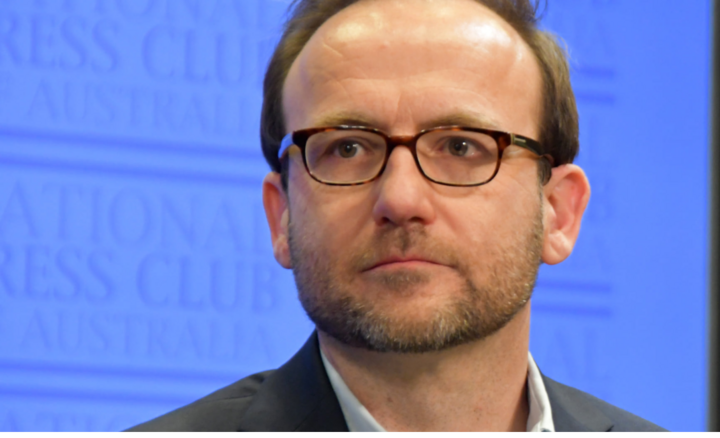
"The hyperscale Project Ares data centre proposed for the Northern Territory markets itself as using renewable energy but in reality it will rely heavily on fossil gas that will make the climate crisis worse and drive up energy bills.
"Data centres must be made to bring their own clean energy, not compete with households and push up their power bills," he added.
Approvals
The concerns over the energy (and water) requirements of the boom in data centres have only been amped up by today's speech, in which he assured developers of faster approval processes for their tech facilities.
Before announcing the creation of the Office of AI under his own remit and a framework of Australian Standards for AI, he listed the "World class universities… the traditional resources, critical minerals and rare earths…the space to build…the sunlight to power affordable, renewable, reliable energy…[the] strong bonds with the fastest growing region of the world in human history…a legal and financial system at the top of the global ladder…and, underpinning it all, a stable democracy" as the "reasons that the world is queuing up to invest in Australia."
"We want more Australian companies and global firms developing AI here. To boost our sovereign capability, to strengthen our national security and build our economic resilience," he added.
"Getting this right will enhance our appeal to international investors by delivering greater clarity and speed for approvals," he said.
However, despite the warmly received speech, the wave of data centres coming to Australia – and now possibly being given a smoother planning approvals process – concerns the likes of Bandt.
"In emphasising speedy approvals for new data centres, the prime minister has his priorities wrong and is not hearing Australians' concerns about AI and data centres.
"The rush to approve data centres, which guzzle power and water, has the potential to derail Australia's clean energy transition," he warned.
According to the research group RenewMap, there are almost 90 projects in development around Australia, led by NSW with 39 projects, in addition to the 145 centres already operating across the country.
And the AEMO has previously said digital infrastructure will account for around 10% of grid power by 2050, up from 2% today.
Estimates vary, but analysts predict Australia's current 20GW pipeline could bring north of $250 billion of capex.
Moratorium
In response to the PM's words, the Greens have called for a moratorium on all new data centre developments.
Senator Sarah Hanson-Young, Greens spokesperson for communications, arts and environment and who is chairing a Senate committee inquiry into AI data centres, said: "AI is the new extractive industry, if we don't have the right rules in place. Big tech companies will take our resources and leave Australians with little to show for it.
"We need a moratorium on the building of data centres until there are laws in place to properly regulate their impact in Australia, including energy, water use, environment and communities.
"It is essential that we get the rules right. To do that we need a pause on the approval and construction of new hyperscale data centres while we do this important policy work.
"Today's announcement that there will be rules for the building of data centres is welcome, but with more than 90 data centres already in the pipeline we cannot allow a free for all in the meantime."
MS' word(s)
Jane Livesey, Microsoft Australia and New Zealand's president, described Albanese's speech as a "clarion call for Australian leadership in the AI era."
"Realising the promise of this technology requires deep partnership across industry, technology and government – all working together to keep AI safe, inclusive and delivering for every Australian. The prime minister's plan gives us the shared foundation to do exactly that."
In April Microsoft committed A$25 billion in new digital infrastructure by the end of 2029 – the firm's largest investment in Australia to date – and signed up to a Memorandum of Understanding with the government committing us to its Expectations of data centres and AI infrastructure developers, which include supporting the country's energy transition, using water sustainably and responsibly and investing in Australian skills and jobs.