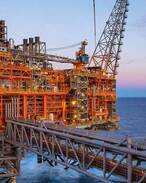
What triggered this interesting thought were reports last week from ExxonMobil and Shell.
In both cases, profits soared but production fell. In the case of ExxonMobil, net income in the June quarter was up 32% to $US7.64 billion – but production of oil and gas was down 4.3% on the June quarter of last year.
At Shell, profit was up 34% to $US5.24 billion, but production was down 1%.
In both cases the production slide can be viewed as modest. And, in both cases there is the promise of higher production levels in the future.
But, and this is the nub of the matter: is what big oil wants what the world wants?
To understand The Slug’s rhetorical question, imagine that you’re a director of ExxonMobil. Right now, it’s about as good as it gets. Oil at $US60 a barrel, or there-abouts, means that the first problem you face is whether to buy a new armoured car to deliver the loot to the Irving, Texas, branch of Wells Fargo Bank.
The second problem comes after banking and is somewhat more tricky – what to do with the cash stash? So far, that answer seems to be launch another share buy-back (which pushes the share price higher) or increase the dividend (which some investors want, and which also pushes the share price higher).
A third point to ponder: increasing oil production and/or exploration, hardly seems relevant when you are achieving your objective as a director by making fat profits and delivering fat returns to the owners of the business, the shareholders (and, by rule of law, the only people you really have to worry about).
On the outside, where $US60 a barrel for oil means pain, there is a sense of disbelief. Surely, right now, is a time when oil production should be boosted, when exploration should be accelerated, when new projects would be brought on line as quickly as possible.
Oh, we’re doing that, says big oil. ExxonMobil says capital and exploration spending rose 25% to $4.5 billion in the second quarter. Shell says it’s doing its best, but continues to hit problems with the latest being a delay at the Bonga offshore oilfield development in Nigeria.
Perhaps big oil is doing it’s best. Perhaps “peak oil” really is starting to bite and the world has entered a period of plateaued production, leading to eventual decline.
But, that cuts to the core of the “big oil v rest-of-the-world” argument because right now there seems to be much greater interest in capital management issues, such as share buy-backs and dividend payments, than there does in finding the oil that the world wants.
In other words, what’s good for big oil might not be good for the rest of the world.
What might be good for the rest of the world is the creation of a series of smaller oil companies that are lean and hungry and share the world’s appetite for discovery and development rather than capital management.
Is this an idle thought on the part of The Slug? Maybe.
Is it a thought which could catch the imagination of governments which want to see more action in the ground, and less in the bank?
Not yet, but watch this space, because it is an idea that has potential and could start with governments forcing the relinquishment of some oilfield leases, handing them to smaller players, with a note attached saying: “Get on with the drilling.”