The week in review
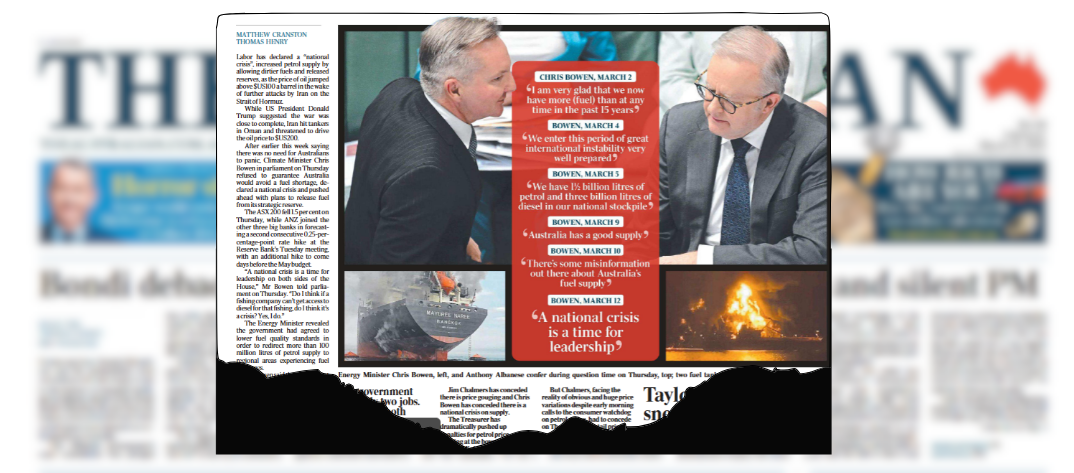
The front page of The Australian newspaper does a good job of summing up the vacillation – or should we say panic – of the government over the ongoing Middle East crisis and its impact on fuel supplies around the country.
From measured and calm responses at the start of the month to a mention of a "national crisis" yesterday to the release of 20% of our nation's fuel reserves today, it's been a heck of a fortnight for Canberra.
Overnight on Thursday, Dr Fatih Birol, the boss of the International Energy Agency, said all the body's 32 member nations had agreed to move to lessen concerns about supplies in domestic markets.
"The oil market challenges we are facing are unprecedented in scale, therefore I am very glad that IEA Member countries have responded with an emergency collective action of unprecedented size.
"Oil markets are global so the response to major disruptions needs to be global too," he said.
A few hours later when Australia woke up, our energy minister Chris Bowen sounded confident the call would be heeded and moves to release Australian reserves would follow.
"Australia is finalising its contribution, which would then be released directly to the Australian market. This is a voluntary action – what contribution Australia makes will be decided in our national interest," Bowen was quoted as saying.
However, in an interview with the ABC later on, he was less effusive, even evasive.
When pressed as to whether Australia might decide not to follow the IEA directive, Bowen said: "We're considering it...We take it very seriously. We're good members of the IEA…it's a very important organisation...It is not a mandatory decision – it's a voluntary call."
When pressed further he reiterated: "We're considering it...We're weighing up what's in our national interest - how we ensure that our response adds to supply in Australia and works to deal with many of the issues that have been raised in recent days and weeks, quite rightly, by people in regional Australia…We are taking the voluntary call very seriously. But I'm considering it and the Government is considering it."
And then today comes an announcement from Bowen that the government "will help to address fuel supply chain disruption by releasing up to 20% of the baseline Minimum Stockholding Obligation for petrol and diesel."
As ENB wrote yesterday, they say a week is a long time in politics, but this is taking the biscuit.
But it all rather begs the question, how can a country which is one of the biggest producers and exporters of energy products in the world, have got into this situation in the first place?
Yes, apparently there's no actual shortage of fuel in the country and that any shortages (and price spikes) that are being seen are as a result of panic buying and stockpiling, but the fact that we rely solely fuel that is imported to us is certainly a cause for concern.
As the former senator and now self-titled transparency warrior Rex Patrick notes, the decline of Australia's liquid energy strengths has been marked.
"In 2002, Australia (under Howard) held over 300 days of fuel stock. In January 2010 (Rudd), Australia had 83 days. In January 2012 (Gillard), Australia was down to 60 days, and in January 2015 (Abbott), we had just 51 days," he writes.
Today we have 34 days' of supplies, according to Bowen, making Australia the only country of the IEA 32 that is failing to meet its treaty obligations to have oil stores equivalent to 90 days' worth of import coverage.
Likewise, "In 2000, we had eight refineries. In 2003, the refinery at Port Stanvac in SA was closed. In 2012, the refinery at Clyde in NSW closed. In 2014, the refinery at Kurnell in NSW closed. In 2015, the refinery at Bulwer Island in Queensland closed. In 2021, the Kwinana refinery in WA and the Altona refinery in Victoria closed," notes Patrick again.
In a world where the Strait of Hormuz can be swiftly brought to a standstill by the Iranians lobbing a few mines over the side of speedboat, this doesn't sound much like energy security to me.
Yours,
Russell Yeo
Editor Energy News Bulletin
To get the best analysis and insight of what's happening in APAC's energy sector, sign up for a free trial.