

One of the newest gleaming skyscrapers in the Perth CBD - the undoubted heart of Australia's energy sector - is the home of Chevron at One The Esplanade on the edge of the capital city's Elizabeth Quay.
The 29 storey tower – complete with its sleep-pods, creche, 300 pieces of Australian art and more than 6000 plants – is a far cry from its facilities on the remote Barrow Island.
YOU MIGHT ALSO LIKE
But thanks to the wonders of modern technology, Gorgon and Wheatstone operations can be brought to the heart of Chevron's city centre home.
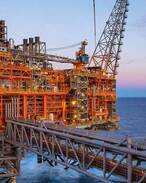
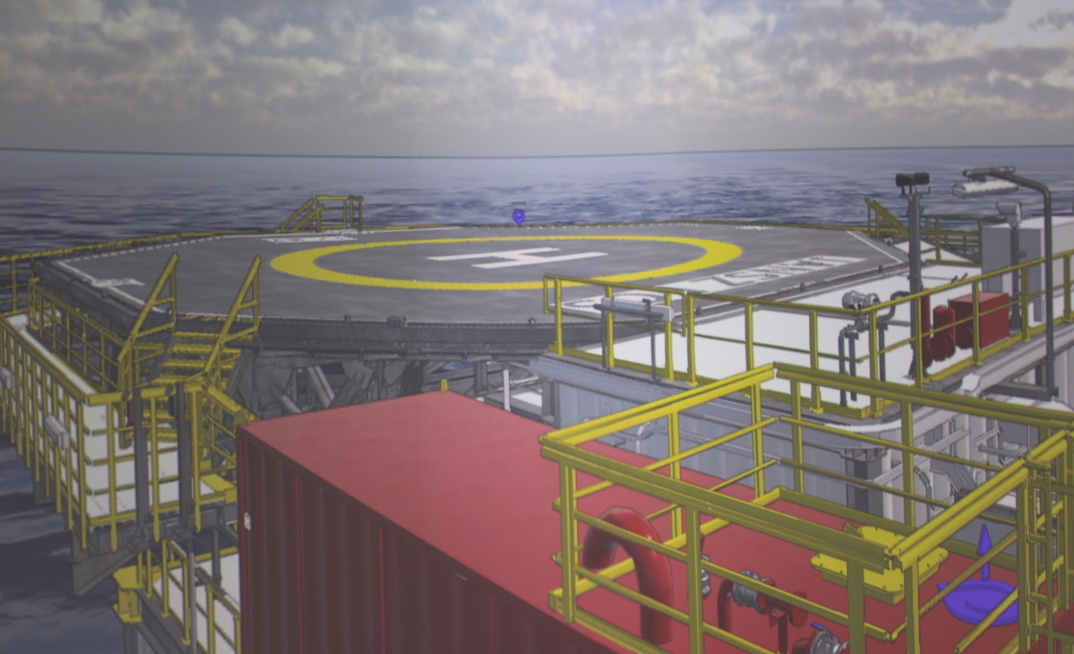
Chevron has leaned into the growth of AI and pushed for its increased adoption into its operations – specifically to use, the technology to improve offshore safety and production efficiency by putting workers into a fully immersive, simulated version of its J-IC floating field control station offshore Barrow Island, all from the comfort of its plush offices.
Known as the igloo, Chevron's workers – as a team - can step into system and be transported onto the platform to view their accommodation, practice emergency procedures and walk through the facility to familiarise themselves with the area, without the need for a helicopter.
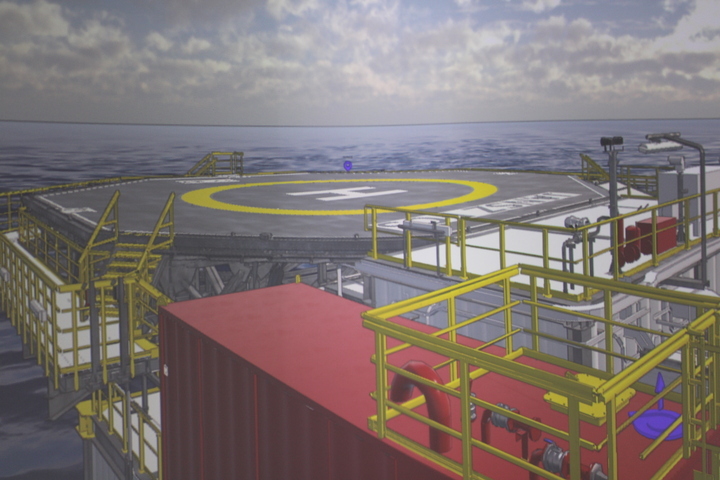
Think of it like stepping into a giant, communal virtual reality headset.
Or for readers of a certain image, the holodeck from Star Trek: The Next Generation.
Chevron Australia general manager for strategic projects, Marty Clough, said the igloo is about leveraging technology to make large-scale assets safer and to conduct maintenance plans more efficiently.
"We have contracts and deliveries every day, so we need to make sure we're meeting our plans and keeping that delivery coming," he said.
"We're getting people more familiar with the assets to execute their jobs more safely.

"For safety, it is going to be a game-changer for us. That's probably our number one priority. And then it's about efficiently executing work. There's some cost benefit, but by far the biggest value for us, other than safety, is reliability and security of supply."
The igloo has so far been used to train Chevron offshore maintenance workers, as well as medical teams and contracted electricians, with the company hoping to use it biannually to refresh training for workers before they are deployed to the physical site.
It eliminates the costs and safety risks of training workers on the actual offshore platform, which is accessible only by helicopter and – as around five people can enter it at one time – it offers a more realistic experience than individual users wearing virtual reality headsets.
There are also cameras in the igloo to stream scenarios to workers remotely, with a team from Korea also being able to participate in the simulated environment from their computers.
Workers in the igloo get a 360-degree view of the offshore platform, can walk up ladders, gather at muster points to deactivate emergency sirens and open doors to make their way through the facility.
To navigate the setback of not having a ceiling view of the platform, Chevron designers have even introduced a control panel which allows the instructor to "look up" virtually on the walls of the Igloo, with the ability to also "fly" to a location on the platform – a teleportation skill workers unfortunately won't have at the Jansz field.
In addition to workers using the igloo, engineers are also taking advantage of another, more routine replicative technology - a digital twin.
In Chevron's case, the digital twin replicates the Gorgon gas offshore facility near Barrow Island and the Wheatstone gas facility near Onslow, using paper designs, multiple images and laser scans fed into a system, which allows engineers to assess maintenance concerns and test their solutions in real time, once again more safely and cost-effectively without the need for a helicopter trip offshore.
"Some of the use cases we've had are when things go wrong. Typically, someone's on-site and you call someone in Perth, and they're getting out their PDF or their diagram, it's not as collaborative," Clough said.
"Whereas now you can both pull up the digital twin. You can say this is where the issue is and you can then collaborate."
Clough said the digital twin AI technology has already proven useful for the company's engineers and allowed production to continue at a faster rate as workers knew exactly what to fix once they arrived at the physical platform.
"We had an instance on the Wheatstone platform where we had a production issue and we had to shut down. Through using the digital twin, we were able to accelerate, compared to previous times, how fast we can actually get it back online," he said.
"Because we've got the engineers in Perth directly collaborating, mapping out what we need to do, doing the isolations in real time, planning it all out, the field can then execute their focus on making sure people are safe, and the facility is safe.
"Engineers in Perth are really driving the solutions."
Clough said Chevron Australia has been leading the AI uptake with the use of the igloo and the digital twin, which can also be brought up via a website remotely for workers at home if they cannot get into their office.
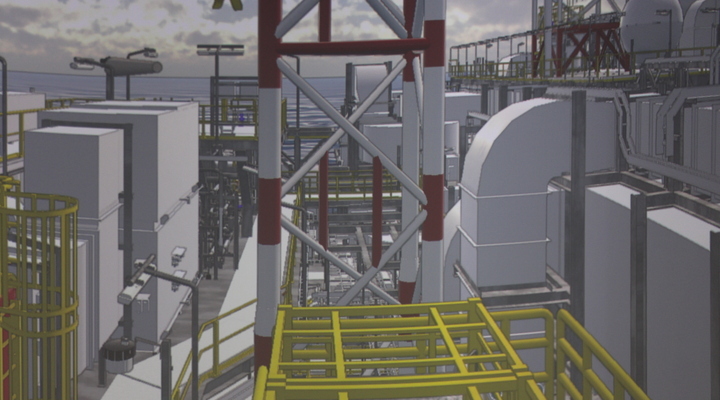
"We're by far the biggest user globally of digital twins, partly due to the scale of assets, due to the remoteness of where they are relative to the offices, but we're seeing every other asset around the company adopt them now," Clough said.
"The future is bright. We can take images of equipment and that image can get uploaded to the digital twin. You can do AI analytics on any change from the last image to see where any corrosion or other damage might be taking place. That's done almost more automated than ever used to be."
The company said it is planning to advance its AI technology solutions to predict trends in when maintenance work will need to take place, eliminating unnecessary and expensive full audits of equipment, and more efficiently meeting government regulations and safety standards.
By eliminating the need for full-team deployment and shutdowns of the site to investigate where the problem may be, the predictive technology - in conjunction with the digital twin and the igloo - will help keep production running offshore, helping unlock energy and gas supply security.
"Chevron is actively driving this space. It's one of our big focus areas, AI," Clough said.