

‘My career had been entirely focused on conventional international big-field oil and gas until I met Bruce McLeod, an industry veteran with a mathematics and economics background. In 1993, I was part of the exploration team that led BP into the Northern Caspian Sea, both in Azerbaijan and Kazakhstan. Eventually the massive Kashagan oil field was discovered with recoverable reserves of about 13 billion barrels of oil - the world's biggest oil discovery since the 1970s.
Bruce McLeod's knowledge of shale geology was cursory, but he knew Empire Energy's producing oil and gas fields in the US overlay prospective Utica Shale sequences in Pennsylvania and New York State.
Listen to Empire Energy's ENB Podcast
From about 2008 onwards, horizontal drilling with multi-stage fracking provided the breakthrough in the USA to enable commercial oil and gas production from tight shale rock, and Bruce had seen the dramatic impact of shale gas on the US economy and simply queried why that couldn't happen elsewhere.
The first thing Bruce asked me during our first lunch meeting in 2010 was ‘What do you know about shale?' That threw me a bit and I said ‘Well, to be honest Bruce, I've spent my life in conventional oil and gas, so I know pretty much nothing about shale other than as a conventional petroleum source rock'. Rather than being the end of the conversation, and to my surprise, Bruce said ‘So, when can you start?'
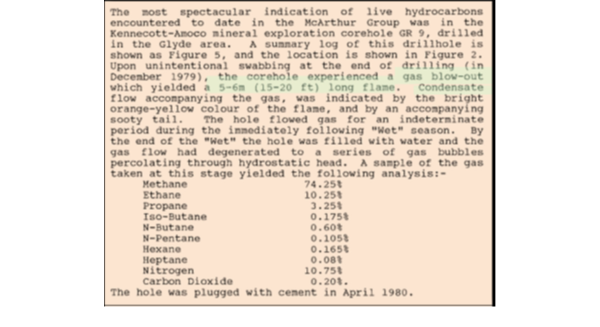
Cutting from Amoco's original report turned up by John Warburton in Darwin
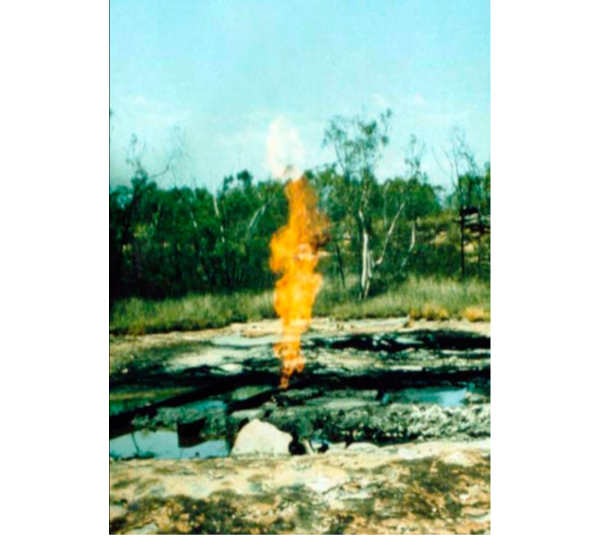
Amoco's GRNT-09 flaring
We agreed I would spend six months finding a shale play somewhere else in the world that Empire Energy could acquire and monetize.
In the previous four years I'd completed a major business development review of South East Asia for a multinational petroleum company. My mission had been to identify big conventional gas exploration opportunities that were geologically simple, easily developed, with a low entry cost, substantial acreage footprint, low fiscal risk and where there was a high chance of finding a super-giant gas field. It was a relatively quick task to screen the entire region once again, and essentially applying the same screening metrics, but this time with a view to shale plays.
Shale gas had been spoken about in Australia for at least a year by 2010 and I'd assumed all the prospective acreage would already have been snapped-up, but not so.
We wanted large contiguous areas at 100% equity, to allow ourselves to be unfettered by others. On the 24th March 2010 I planted myself in the Information Centre of the Northern Territory Geological Survey. One particular report described the results from a mineral well named GRNT-09. It had been drilled by Amoco Minerals in the Glyde Sub-Basin back in 1979 during their exploration for lead and zinc mineralization in the vicinity of what is now Glencore's zinc-lead McArthur River Mine in the McArthur Basin.
These metals were hosted in ancient black shale formations laid down in a relatively deep-water sedimentary basin an astonishing 1.64 billion years ago during the Palaeo-Proterozoic Era. If I may, I'll tell you a bit about how these extraordinary rocks formed.
They were of enormous interest to me as a petroleum man. The atmosphere of the early Earth from about 3.5 to 2.5 billion years ago had only a small fraction of the present-day oxygen level. That was because all the oxygen created by photosynthetic blue-green algae - at that time some of the earliest life-forms on Earth - was captured by iron in the oceans to form the thick banded iron-ore formations. After the free iron available in the early oceans was exhausted oxygen levels increased modestly until about 2 billion years ago and yet the oceans remained relatively ‘anoxic' - starved in oxygen.
Those conditions allowed for the preservation of organic carbon and the deposition of black carbonaceous, sulphide-rich black shales. The best analogue today is around the deep-sea ‘black smoker' hydrothermal vents where life thrives in the form of bacterial colonies, shrimps and crabs.
In the Proterozoic the dominant life form on Earth was prolific forming cyanophyte, or blue-green algal blooms. These rained in vast numbers onto the sea-bed forming layers of concentrated carbon in what become shale rock. The sulphide layers were interbedded with layers of black shale that was also raining down from the oceanic water column. And it still amazes me that world-class zinc-lead deposits can be interspersed with layers of world-class organic petroleum-prone black shale.
But the real lightbulb moment came as I ploughed through the completion report for the 1979 Amoco 534m deep GRNT-09 mineral well. The rig had struck a layer containing natural gas and caught fire! It was a mineral well so didn't have sophisticated blow-out preventers that are requisite on petroleum wells. A grainy photo of the flaming gas showed it blew six meters or so into the air and had a yellow smoky appearance indicating the gas contained condensate liquid or light oil.
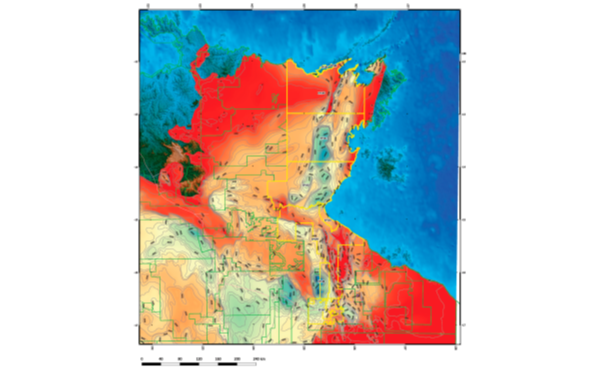
A map with the Empire tenements in yellow
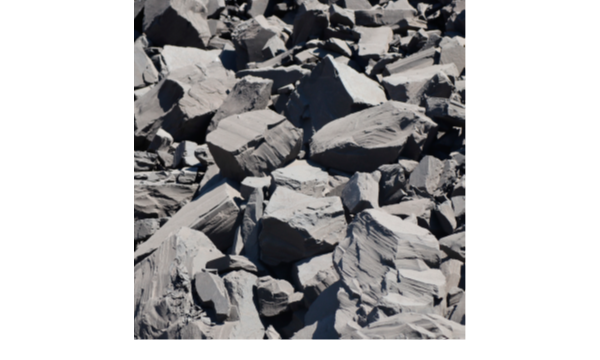
Tight shale' in the pit at McArthur open-cut mine where oil and gas have largely been vented to the atmosphere over time
The well burned into the wet season until the hole had filled with water and the gas escape was reduced to bubbles. Somebody in Amoco had the presence of mind to sample that gas which comprised about 75% methane plus heavier components of C2 to C8 and with very little carbon dioxide contaminant. It had intersected a viable petroleum source in the Barney Creek Formation which had been historically mined for lead and zinc. I simply then used the Northern Territory Survey geological maps to track the geographic distribution of that rock formation.
I phoned Bruce and said ‘Look, we are potentially onto a winner here, this is a shale play that fits all our screening metrics'. As far as I was aware at the time nobody else had spotted it. This was what we'd been looking for. An aerially extensive, proven gas and liquids-rich petroleum system in our own ‘back-yard', not overseas.
The Barney Creek Formation was estimated by the Survey Geologists to be up to 900 meters thick in places, almost an order of magnitude greater than many of the US shale fields. The area that contained the Barney Creek Formation was mostly flat, sparsely vegetated stony land with little agricultural potential, so subject to Traditional Owner approval, the play could be accessed, exploited and remediated quite easily. On the 26th March 2010 I applied for seven license areas occupying 59,000 square kilometres, or about 5% of the entire onshore Northern Territory - an area about the size of Croatia.
At the time that I was submitting Empire's License Applications a competitor, Armour Energy, unknown to us was also active. Amour's presence became evident when two of the areas for which I had submitted applications were refused by the Northern Territory Petroleum Licensing Department. Evidently, and just days before, Armour had also submitted applications for the same two licenses to the south of Empire's acreage.
Armour Energy has since drilled a number of successful exploration wells, including one with a horizontal leg. Those wells have confirmed the Barney Creek Formation shales, despite being 1.64 billion years old, are a prolific and potentially commercially viable petroleum system. Being exceedingly old, almost one-third of the age of the Earth itself, such ancient rocks like these have typically been deeply buried, suffered recrystallization or even melting depriving them of any petroleum.
The rocks of McArthur and Beetaloo Basins have never been buried so deep as to ruin their petroleum prospectivity. It is very clear that during their history they experienced just the right pressures and temperatures for petroleum generation and preservation - almost like a petroleum Goldilocks zone.
Page 2
What are the chances that the McArthur and Beetaloo Basins can make Australia self-sufficient in liquid fuels?
I genuinely believe there is a very high chance that shale petroleum will play an enormous part in Australia's energy self-sufficiency - and ultimately exports. The numbers quoted by most operators for the volumes of hydrocarbons, albeit currently at ‘prospective resource' status, are enormous. They dwarf Australia's proven present-day conventional oil and gas volumes.
The Northern Territory Geological Survey's estimate that in excess of 500 Tcf of gas-in-place is present just within the Middle Velkerri Shale in the Beetaloo Basin. Empire's independent expert certification is that the P50 or ‘most likely' resource in Empire's acreage to be about 2 billion barrels of oil equivalent - or 13 Tcf equivalent of gas - but is up 5 billion BOE at P10. This is a substantial prospective petroleum volume and yet is conservative when compared with And that hugely conservative assuming main shale formation, the Barney Creek Formation is 100m thick - and can be up to 900m thick. They've also assumed up to 75% of the shale formation is not petroleum-bearing. And we have the McArthur Basin potential on top of that.
The part of the McArthur Basin within Empire Energy's acreage occupies a similar area to the USA's Fayetteville Basin. After many years of drilling, the US Department of Energy has estimated the Fayetteville contains about 42 trillion cubic feet of gas.
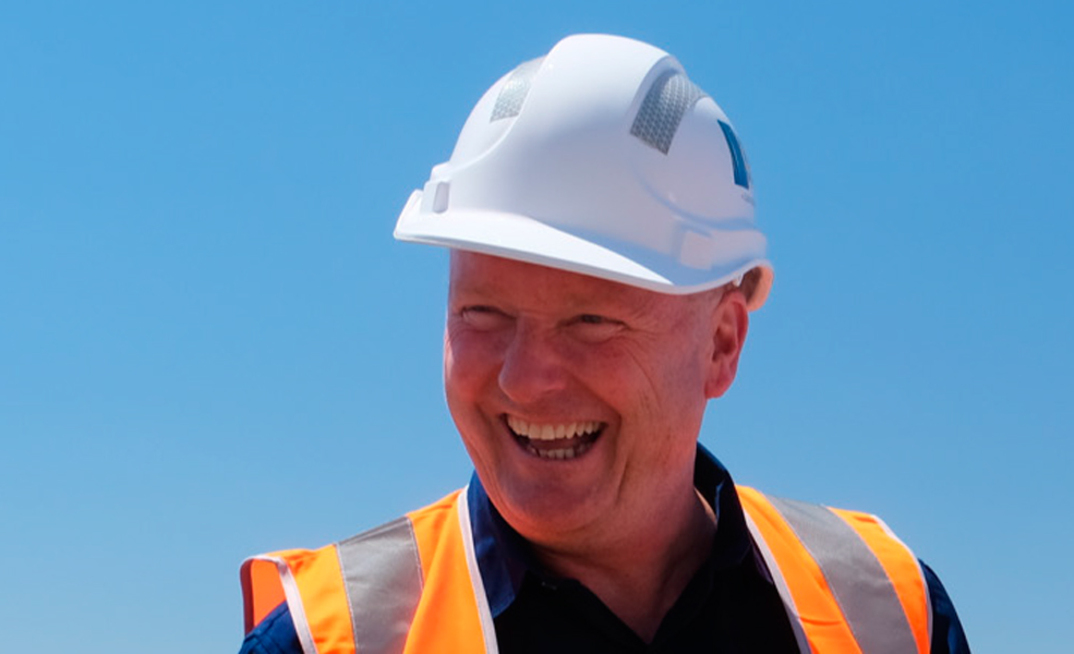
 Empire Energy Managing Director Alex Underwood examines a slither of partly weathered shale
So how do you know where to start exploratory drilling in such an enormous area? Isn't it like a needle in a haystack?
The US has been developing shale petroleum for a number of years now and geologists have a good knowledge of where the richest shales or ‘sweet spots' are located. The rule-of-thumb from the USA, from hindsight, is that about 10% of the area of a shale play is a real sweet spot. Furthermore, it's suggested that the sweet spot contains about 45% of the total economic value of the basin. So clearly that's where you want to start drilling.
Early sweet spot development enhances the project economics; achieving good early production rates means the initial investment will be paid back quicker. Lower quality shales can be exploited later.
How do the Geologists go about predicting shale petroleum sweet spots in a basin?
You look for the relationships between the color, hardness and composition of the various layers of rock and identify which layers have the high organic carbon content. You also look at the fine sedimentary structures that describe the conditions in which the sediment was originally laid down. Those details will tell you a lot about how the rock was deposited, whether sand was being introduced into the basin diluting the shales, and whether the environment was anoxic, so the carbon content is preserved. And then you correlate the rock layers between many wells and mineral cores and see if they are continuous over great distances or fragmented.
This approach will allow you to draw contour maps such as for total thickness of black shale layers with high organic carbon, the depths at which the rocks are buried, and determine if they are deep enough to generate oil and gas. The areas with thick shale, little sandstone dilution, large number of layers with organic carbon, at the right palaeo-temperature and at optimum depth to drill will be the sweet spots. Seismic data helps establish the horizontal continuity across the basin and identify local geological complexities to stay away from.
Analyzing the shapes in the rock layers on seismic tells us about the relative sea-level under which successive rock layers were originally deposited, and the likely overall chemistry of the rocks at different depths. You can say ‘right, we see a particular shape in the seismic data, that's a particular place of interest'.
I'm really looking forward to seeing first-hand the seismic data we are acquiring across EP187 right now.
As a frontrunner, Empire Energy acquired not just a sizable portion of the Beetaloo Basin, but also a major segment of the older McArthur Basin. Along with Empire, only Armour Energy has substantial claim over the McArthur which may have an even greater potential than the Beetaloo.
How will Empire commercialize its gas?
The supply-demand conversations and possibilities between the Northern Territory and Queensland are real. In 2018 Jemena constructed the Northern Gas Interconnector between Tennent Creek and the eastern pipeline network connecting the systems at Mt Isa. Such investment proves there is already growing and Australia-wide recognition of the energy potential of the Northern Territory shale basins.
Empire Energy plans to start commercial gas production as early as possible initially with customers from the local mining and fertilizer industries looking to replace diesel with cleaner and cheaper gas. The McArthur River mine has a gas pipeline that passes right through Empire Energy's license EP187. Longer-term, if there really are of the order of 29 trillion cubic feet of gas, which external assessments currently attribute to Empire Energy's McArthur Basin acreage, this will lead us to the possibility of LNG of exports and examining Australia's strategic security of supplies, also in liquid fuels.
Empire's prospective shale acreage extends 600 kilometres, south to north, up to the very top end of East Arnhem Land. Near the site of Pacific Aluminium's now-closed Gove Refinery there is functioning deepwater port at Nhulunbuy in East Arnhem Land just 80 kilometres to the east of Empire Energy's northernmost exploration area. Furthermore, a right of way for a 600-kilometre spur pipeline from Katherine to Nhulunbuy has been surveyed and passes right through Empire Energy's tenements EPA 180 and EPA 181.
The town of Nhulunbuy is in one of Australia's most northerly locations and faces the South East Asian LNG markets. We are extremely well-positioned to be a substantial player in the emerging shale petroleum export story.
My personal view is that the industry must embrace the conversation about this new frontier, about energy security and of the huge potential for the exporting liquefied natural shale gas. It created a massive change in the USA with daily shale gas production increasing dramatically from about 2 Bcf [billion cubic feet] in 2007 to 50 Bcf in 2015 - with a 10% decrease in national annual carbon emissions. There will be intense market pull, both domestic (from gas usage and prices) and international (for LNG) if the shale resource is realized. That's my personal view.
John Warburton BSc Hons Geological Sciences, PhD Structural Geology, FGS, FPESA, MAICD
John is a Non-Executive Director of Empire Energy Group. Previously he spent 14 years with BP Exploration where he held senior technical and management positions then moved to senior positions with substantial oil and gas companies including LASMO plc, Eni Pakistan Ltd and Oil Search Ltd. John is an Independent Non-Executive Director of Senex Energy Ltd and Visiting Professor in the School of Earth & Environment at the University of Leeds, UK.
ABOUT THIS COMPANY
Empire Energy

Empire Energy Group Limited is a publicly listed oil and gas exploration and production (E&P) Company focused on onshore long-life oil and gas fields.
HEAD OFFICE:
- Level 1901, 20 Bond Street, Sydney, NSW, 2000, Australia
- Tel: 292511846
- Website: empireenergygroup.net/
- Email: [email protected]