The week in review
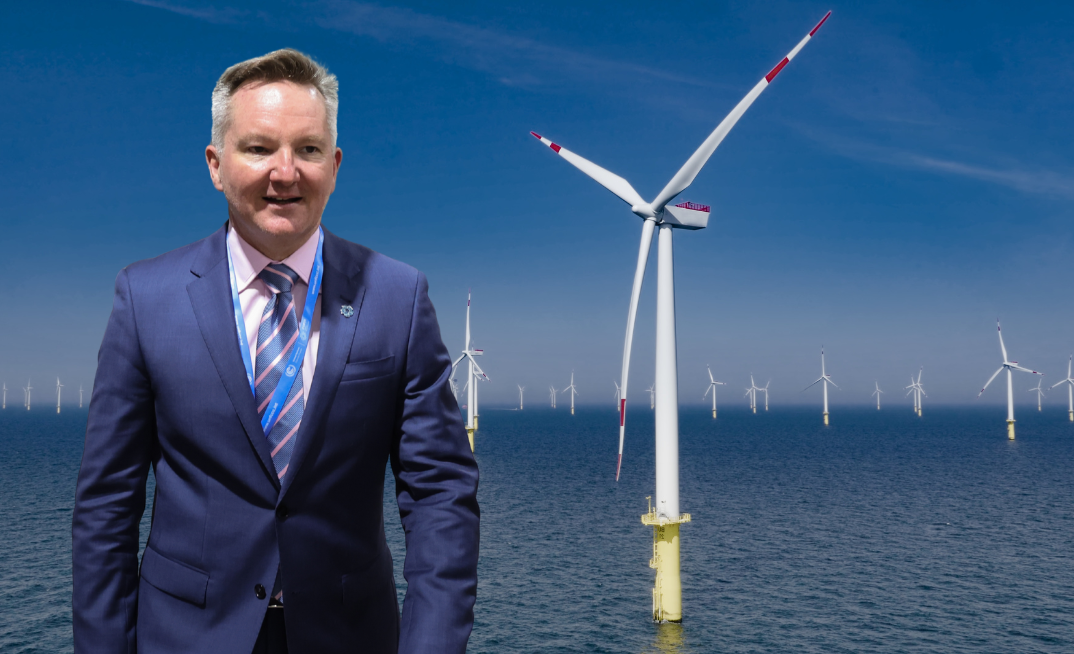
There was big news this week in Australia's immature offshore wind sector – news which shows the difficulties developers and governments face in getting this important addition to the country's energy mix up and running.
The federal government is quite clear about the role offshore wind can play in Australia's future and has developed a framework for offshore wind generation in Commonwealth waters and proudly states on its website that "Offshore wind will support potentially thousands of well-paid jobs during construction and ongoing, and provide plenty of cleaner, cheaper renewable energy."
And why not? Australia's vast coastline and strong, consistent wind provides excellent opportunities for offshore renewables. In fact, it should perhaps be questioned why no government's before Albanese's have thrown themselves into the sector.
So – as many of you will know – in August 2022 the energy minister Chris Bowen kicked off the whole process when he formally declared six proposed areas which were considered ripe for development.
And three years later – where are we? To be honest, not that much further on.
Of course, these things take time and so the first step was for developers from near and far to do some desktop modelling and then submit their ideas to the Department of Climate Change, Energy, the Environment and Water.
Then, once those were given a good going over by Canberra officials, a number of feasibility licenses (permission slips for a developer to formally assess the notion of building an offshore wind farm) have been granted by the government.
Twelve licenses were granted for Gippsland zone; Spinifex was granted the only license for the Southern Ocean zone; two projects have been shortlisted for a feasibility licence in Indian Ocean declared zone (note, shortlisted, not granted); and in the Hunter zone, one license was granted to the Novocastrian project.
In the Illawara, BlueFloat Energy - the only firm expressing any desire to propose a development - formally asked the government to "consider not offering any licences in the Illawarra zone until after the upcoming federal election." And we await a next move.
And in the Bass Strait region, the government is now considering applications for feasibility licence, after the application period closed on 10 April 2025.
So, at first glance it looks like the Gippsland zone is a go-er but interest is luke warm at best in the other areas.
And, as an early indication of the ill-winds in the sector (by the way, writing about offshore wind is a headline writer's dream) Norwegian firm Equinor – a globally important renewables developer and one of the parties behind the Hunter zone's Novocastrian plan – has actually stalled on whether it wants to accept the feasibility license. And they're still considering its next move.
And so, has progress been swift and decisive since those licenses were issued? Hardly.
Only five developers have moved on from receiving their license to submitting a management plan – outlining how they will conduct the feasibility studies. And while all five of those plans have been accepted by the government meaning investigations can start, it's worth noting they're all in the same declared zone - off the coast of the Gippsland region of Victoria.
And then this week came the double whammy of bad news.
Equinor announced they were exiting the joint venture they had been part of to develop a wind farm in the Bass Strait, leaving local developer Nexsphere without a major partner.
And this news came a day after speculation rocketed that BlueFloat might leave the Australian market altogether after it was announced a major transmission link – vital to get the offshore generated power to population hubs – was being delayed by two years.
And these are simply the latest in a long line of developers who have dropped out of the race or scaled back their plans. Previously Alinta Energy and Oceanex Energy both ditched their plans for projects off the Bunbury coast in favour of east coast developments, German developer Skyborn Renewables withdrew from Australia altogether and Flotation Energy even went head to head in court with the government over the failure of their Seadragon Offshore Wind project to get a feasibility license before also pulling out of the race.
So why is Australia so challenging for these developers who, over in Europe particularly, have seen such success?
Oceanex chairman and co-founder Andy Evans said summed it up well, when announcing their change of direction - "green tape."
"As a country, we really make it hard for ourselves. All I think industry wants is just certainty on timelines to get projects up and going," he said in January.
"It's the old saying, 'time kills projects.' That is no truer than in the development phase."
While Europe is compact, with population centres near to the offshore zones and with well-established transmission links, in Australia that's far from the case.
Add that to miles of state and federal red tape, regulator scrutiny and environmental opposition, and it's perhaps not surprising these developers are pulling stumps.
Matt Rennie, co-chief executive at transition advisory Rennie, sees this and says the proponents' struggles showed offshore wind was "commercially hard and getting harder."
But Satya Tanner, chief executive of Danish renewables consultancy LAUTEC Australia, said she was still confident offshore wind would develop in Australia.
"There are always going to be a lot more developers interested than there are projects that will potentially become viable, so it's just part of the natural competitive process."
Australia's offshore potential is massive. Depending on the size of turbines used in an offshore wind project, a single project may be capable of producing 1.5 to 2 GW of energy (one gigawatt can power almost a million homes in a year). Compare that to Eraring Power Station - Australia's largest coal fired power station which will be closed down in a few years – with its overall generating capacity of 2.9 gigawatts, accounting for 25% of New South Wales' power requirements.
With those kinds of figures in their back pocket, don't expect the government to be giving up on their offshore wind plans anytime soon.
Yours,
Russell Yeo
Editor
Energy News Bulletin
To get the best analysis and insight of what's happening in APAC's energy sector, sign up for a free trial.